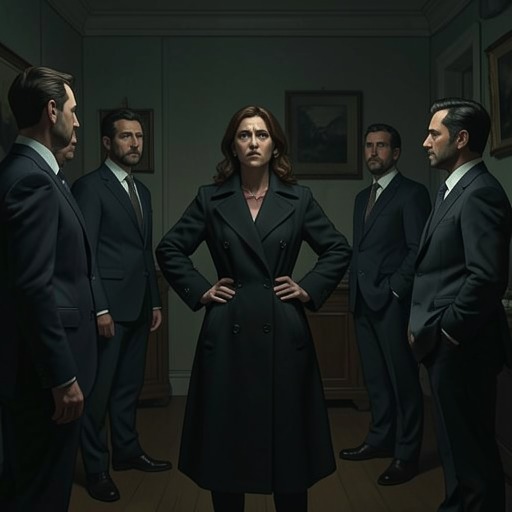
Checquy—Grafters
The RookThe relationship between the Checquy and the Grafters moves from open war to an apparently decisive suppression, then re-emerges as covert infiltration and a contested proposal for alliance. Its central irony is that the Checquy’s victory was meant to end the Grafters’ existence, but the methods used to secure that victory helped leave a history of grievance that later shaped the Grafters’ return.
War and the Supposed End
In 1677, the Grafters’ creatures came ashore on the Isle of Wight, beginning a supernatural war on British soil. The Checquy deployed the Pawns under the Rooks’ direct command. Fighting continued for three weeks, with hundreds of civilians killed; the Checquy gradually reduced the invading force, but bringing down each Grafter creation cost dozens of its soldiers. The campaign’s scale made the conflict more than a contest between organizations: it devastated a village and left nearby fields toxic.
A group of twelve Checquy troops, described as the last anthropophagi in the British Isles, killed seventeen monsters. Pawn Hamish McNeil, himself a leper, released a disease against Grafter forces that caused their bodies to fail. These actions helped wear down the invasion, but the final obstacle was the Grafter general, who resisted every attack the Checquy could muster. Crimson Rook John Perry, the only surviving Rook, linked his mind to the general’s and shot himself, killing them both. The victory therefore ended in a sacrifice that also exposed how badly the Checquy had been depleted.
Treaty and Erasure
After the invasion, Charles II reportedly wished to use the Checquy’s apparent superiority as grounds to invade Belgium. The organization’s Lords and Ladies warned that its forces had been decimated and its most capable generals killed. The King accepted their assessment, and negotiations with the Belgian ruler followed. The Checquy concealed the weakness revealed by the war while securing a treaty that required the Grafters’ dissolution.
The agreement required the withdrawal of funds, the termination of experiments, and the confiscation of Grafter estates and property. Under Checquy supervision, the project was dismantled: leaders were executed before witnesses, scientists were killed discreetly, facilities and barracks were burned, and altered entities—including human beings—were put to death. The process took months, in part because the creatures were difficult to eliminate. Servants and bureaucrats connected to the project were pressed to forget what they knew and take up new occupations. With records of executions and destruction in hand, the Checquy believed the Grafters had been comprehensively removed; there appeared to be no unaccounted-for members and no reason to expect a return.
That declared ending also set the terms of the relationship’s later reversal. The Checquy treated the Grafters’ disappearance as a successful containment of danger, while the Grafters remembered the destruction of their homes, the killing of their associates, and the disposal of their remains. The apparent completeness of the settlement concealed a gap between the Checquy’s account of closure and the survivors’ experience of defeat.
Infiltration Exposed
Centuries later, the possibility of Grafter survival becomes an immediate Checquy security crisis. During a discussion about the organization’s Retainers, Shantay Petoskey points out that the Croatoan policy had been modeled on the Checquy’s, under which Retainers were not supposed to have powers. Yet some Retainers had produced concealed weapons from pouches in their skin and struck with unusual force. Shantay reasons that these abilities must have resulted from later bodily modifications, something she associates with the Grafters. Myfanwy confirms the implication: the Checquy has been infiltrated.
The revelation unsettles the Court because the Retainers cannot be assumed to be the only compromised group. Lady Linda Farrier observes that any Retainer could be a traitor, while Myfanwy warns that the known betrayal by Rook Gestalt makes it impossible to assume that powered Checquy members are trustworthy. Her flippant suggestion that the Retainers be killed is taken seriously enough to alarm her; she objects that the organization cannot simply murder its staff. The exchange makes the practical consequences of infiltration plain: suspicion threatens to turn the Checquy against the people who serve it, even as no one can confidently define the breach’s limits.
The crisis also changes the meaning of the Checquy’s own procedures. Its representatives insist that Retainers are screened thoroughly, including physical examinations. Shantay’s deduction answers that confidence not by showing the examinations were superficial, but by suggesting that the modifications came later. A system designed to identify powered or altered staff has not prevented the enemy from changing its means of concealment. The infiltration therefore challenges both the Checquy’s trust in its screening and its ability to distinguish ordinary service from covert allegiance.
Gestalt and the Breach Within
Myfanwy’s interrogation of Gestalt connects the infiltration to a senior member of the Checquy rather than leaving it as a problem among Retainers. She confronts him with evidence that he has associated with the Grafters, and offers the possibility of leniency if he speaks openly. She also presses him about a moment when he disappeared from view, suggesting that his unexplained absence may have disclosed an additional aspect of his capabilities. Gestalt does not simply deny the accusation; he turns the exchange toward Myfanwy’s own hidden power.
Gestalt says that those present noticed Myfanwy affecting people across the room, although they had believed she needed physical contact to control someone. He further claims that the Court had worked to place her in its ranks because it did not expect her to have the resolve to use that ability. His accusation makes the interrogation reciprocal: Myfanwy is trying to uncover the extent of Grafter collaboration, while Gestalt exposes the gap between what the Court believed about her and what she can do. The scene shows how infiltration and institutional secrecy have compromised ordinary tests of confidence; each side has reason to believe the other possesses knowledge withheld from the Court.
A Threat Reframed as Alliance
When Myfanwy confronts Graaf Ernst von Suchtlen, he rejects the idea that the Grafters’ objective is simply to invade England or conquer territory. He calls the earlier invasion disastrous and emphasizes that it had been driven largely by his country’s rulers. The new strategy, he explains, is not territorial conquest but leverage over the secret world the Checquy governs. In a smaller, more interconnected world, neither organization can make an international war disappear, and neither can allow its existence to become public knowledge. The Checquy’s need for secrecy thus becomes a constraint that an adversary can exploit.
Myfanwy answers that the Checquy would not surrender and that a war between the organizations would be hard to conceal, damaging England as well as the Checquy’s ability to protect in secrecy. She also observes that von Suchtlen has come secretly, without informing his own partner. From this, she infers that he has come to negotiate a merger rather than demand surrender. The proposed alliance grows out of a mutual vulnerability: the Grafters do not want to die, while the Checquy cannot accept their unregulated existence or fight them openly without endangering its central mandate.
Von Suchtlen explains that he once intended to hide the Grafters’ continued existence and inflict pain on the Checquy. Over time, he says, his resentment softened. Watching the Checquy expand and improve led him to regard it as a flawed but potentially suitable governing body, with aims he considered noble. He describes approaching his cousin about reconciliation while continuing to build collaborators inside the Checquy—not, by his account, to destroy it, but to make cooperation appear in the Checquy’s interests. The account complicates the meaning of the infiltration without clearing it of danger: the organization’s hidden collaborators are simultaneously instruments of pressure and part of a long effort to create conditions for negotiation.
Significance of the Relationship
The Checquy–Grafter relationship is defined by incompatible memories of the same defeat. To the Checquy, the treaty and the subsequent dismantling appeared to conclude the danger; to von Suchtlen, the destruction of Grafter homes and associates made the Checquy an adversary whose continued power had to be concealed from or countered. His later willingness to forgive does not erase the original violence or the clandestine means he chose to pursue partnership.
The conflict also exposes the cost of the Checquy’s secrecy. Its mandate limits open war, yet the same need to keep the supernatural world hidden gives the Grafters leverage and makes infiltration particularly consequential. By the time the relationship is described as a possible alliance, trust has already been damaged by concealed modifications, collaborators, and Gestalt’s betrayal. Cooperation is imaginable, but it cannot be separated from the history of forced dissolution or from the pressure that brought the Checquy to consider it.